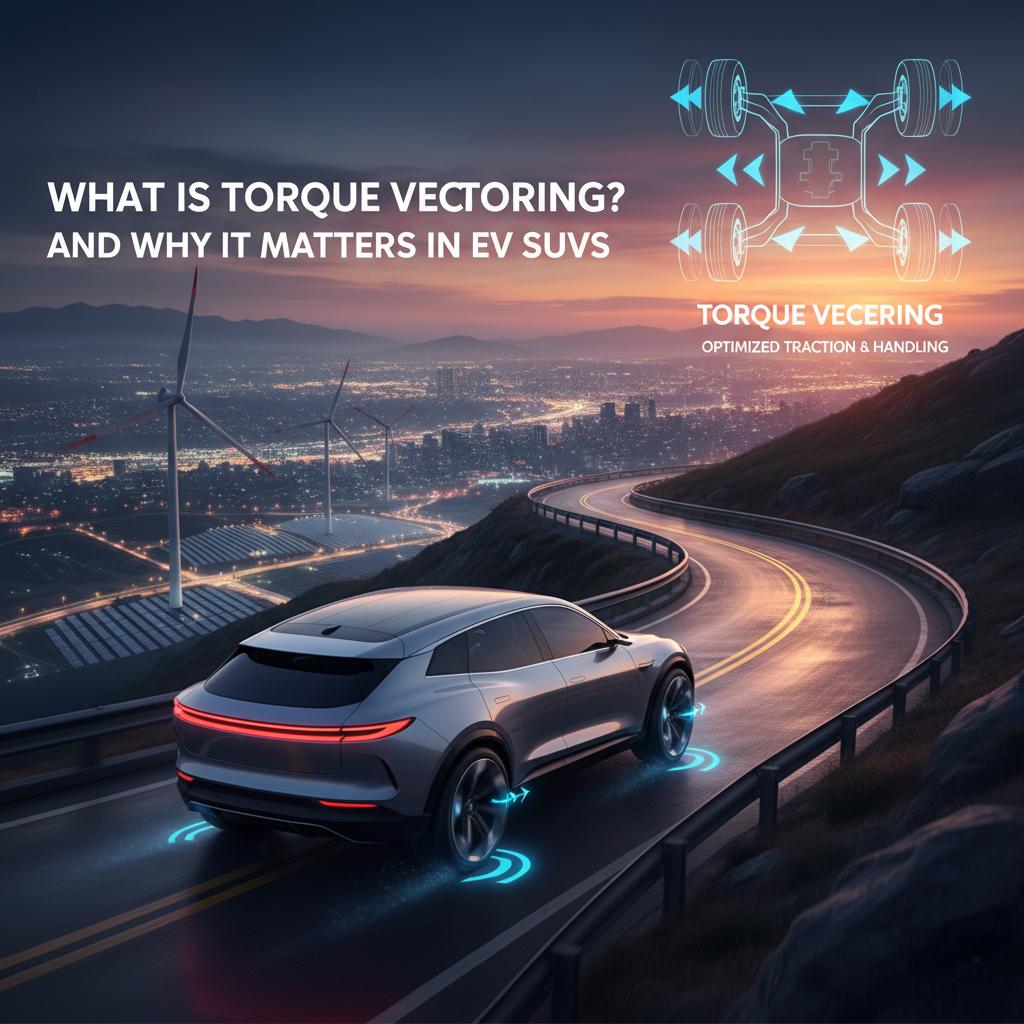
Quick take: Torque vectoring is a control system that sends different amounts of power to each wheel to improve grip, stability, and cornering. In EV SUVs, it’s faster and more precise than in gas cars because electric motors can change torque almost instantly.
Why EVs Make Torque Vectoring Better
-
Instant response: Electric motors deliver and cut torque in milliseconds—ideal for stabilizing the vehicle mid-corner or on slick roads.
-
Independent control: Dual-, tri-, or quad-motor setups can apportion torque to each axle—or even each wheel—without clutches or heavy differentials.
-
Seamless with regen: The system can also vector regenerative braking torque, helping the car rotate smoothly while recovering energy.
How It Works (Without the Jargon)
Torque vectoring monitors steering angle, wheel speeds, yaw rate, throttle, and grip. Then it:
-
Accelerates an outside wheel (or whole axle) to help the SUV rotate into a turn (reduces understeer).
-
Brakes or reduces torque at an inside wheel that’s slipping.
-
Balances left–right and front–rear torque to keep the vehicle pointed where the driver steers.
Types of Torque Vectoring in EV SUVs
-
Brake-Based Vectoring (software-only add-on)
-
Uses the friction brakes to slow a spinning inside wheel.
-
Pros: Cheap, available on many models.
-
Cons: Adds heat, wastes energy, less effective in sustained driving.
-
-
Axle Motor Vectoring (dual-motor AWD)
-
Varies torque between front and rear axles.
-
Pros: Big stability/traction gains; efficient.
-
Cons: No independent left–right control on each axle.
-
-
Wheel-Motor or Dual-Motor Per Axle Vectoring
-
Independent motors per wheel (or a motor + clutch pack) for true left–right control.
-
Pros: Maximum precision, excellent cornering and snow/ice performance.
-
Cons: More cost/complexity; added weight.
-
Why It Matters in Daily Driving
-
Cornering confidence: Reduces push/understeer in long highway ramps or mountain roads.
-
Bad weather security: Helps you pull away straight on snow, wet leaves, or gravel without fishtailing.
-
Better towing stability: Manages axle load shifts and trailer-induced wiggle by modulating torque.
-
Off-road control: Sends power to the wheel with grip when another is in the air or on loose rock.
-
Less driver fatigue: The SUV tracks with fewer tiny corrections on uneven or cambered roads.
Range and Efficiency: What’s the Impact?
-
Brake-based systems can hurt efficiency when used often (turning energy to heat).
-
Motor-based vectoring is largely efficient; in steady cruising it’s mostly idle.
-
Net effect: Small in real life; driving style, speed, tires, and temperature influence range far more.
Safety, Tires, and Maintenance
-
Works alongside stability control and ABS. If vectoring can’t hold a line, stability control still intervenes.
-
Tire wear: Hard cornering plus vectoring can increase shoulder wear; rotate on schedule and keep pressures right.
-
Maintenance: Mostly software; fewer mechanical parts than clutch-based systems in gas cars.
Shopping: What to Look For on a Spec Sheet
-
Number of motors: Dual-motor AWD is the baseline; per-wheel control is best for performance and snow.
-
Claims vs reality: “AWD” ≠ torque vectoring. Look for phrases like “active torque distribution,” “left–right torque control,” “yaw control,” or “dual-motor rear axle.”
-
Drive modes: Snow/Trail/Sport modes often change the vectoring strategy.
-
Regen tuning: Models that vary regen left–right feel smoother and more planted in bends.
Test-Drive Checklist (5 Minutes)
-
Empty roundabout/on-ramp: Enter smoothly at moderate speed; feel whether the nose tucks in or pushes wide.
-
Mixed traction start: With two wheels on paint or leaves, accelerate gently—listen for scrabble and notice if it stays straight.
-
Lift-off in a bend: Ease off the pedal mid-corner; the SUV should remain calm, not snap oversteer.
-
Tight U-turn: Check for clean, controlled rotation without excessive inside-wheel scrubbing.
-
Regen feel: In a gentle bend, lift slightly; good vectoring + regen keeps the line tidy.
Myths—Quick Answers
-
“It’s only for racing.” No—its biggest benefits are traction and stability in everyday weather.
-
“All AWD systems are equal.” Not close. Some are open diffs with brake nips; others have true motor-side torque control.
-
“It kills range.” Motor-based vectoring is efficient; impact is minor compared to speed and temperature.
Bottom Line
Torque vectoring makes EV SUVs safer, calmer, and more fun—especially in poor weather or on twisty roads. Prioritize motor-based systems (ideally with left–right control), verify how the brand implements it, and use the test-drive checklist to feel the difference for yourself.