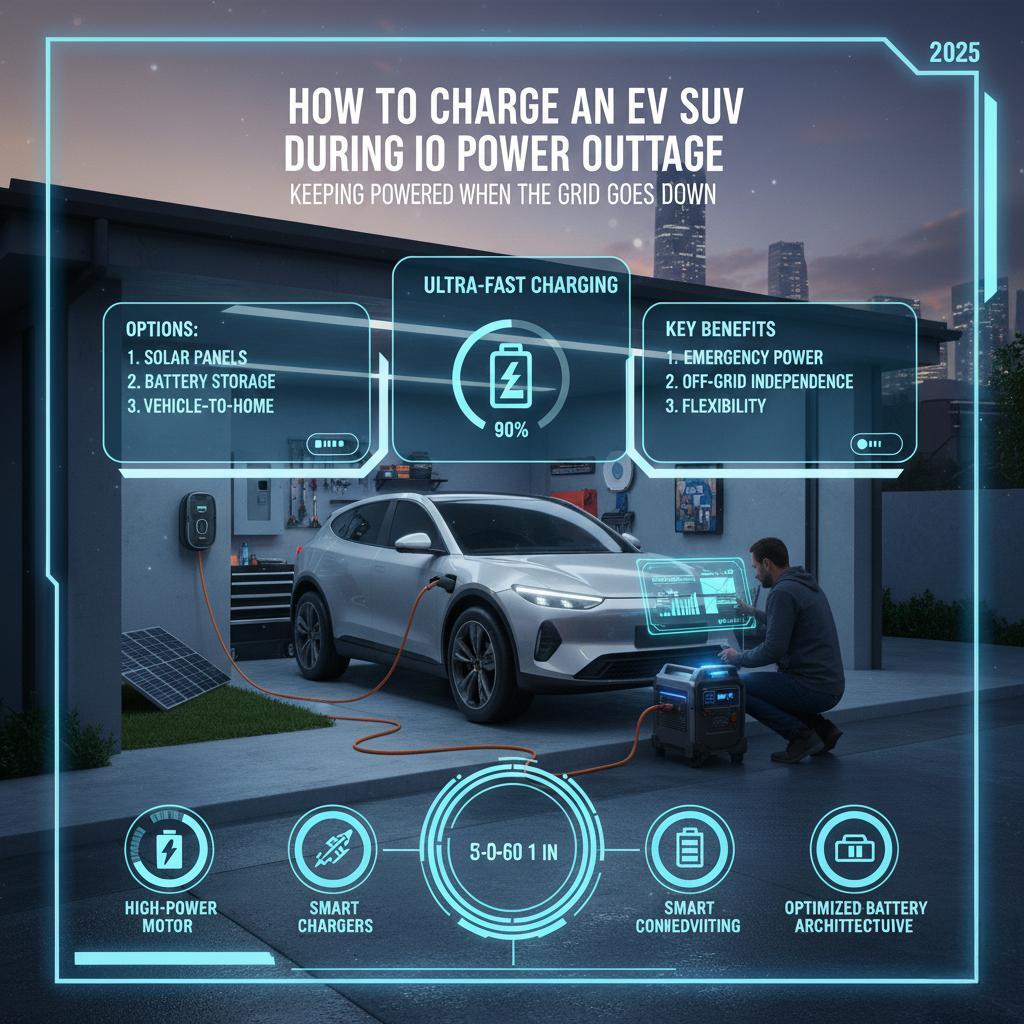
Quick take: In a blackout you can still add range—just slowly. The practical options are portable power stations (battery “generators”), inverter generators (petrol/propane), or a solar-plus-home-battery system that can “island.” Use low-amp charging, keep everything outdoors and dry, and follow local electrical codes.
Your realistic options (from simplest to most capable)
1) Portable power station (“battery generator”)
-
What it is: A big lithium battery with AC outlets (often 1–3 kW continuous).
-
How to use: Plug your portable EVSE into the AC outlet, set the car/EVSE to low amps (e.g., 6–10 A @ 230 V in EU, 8–12 A @ 120 V in NA).
-
What you’ll gain: Roughly 3 miles (5 km) of range per kWh added for many EV SUVs.
-
2 kWh unit → ~6 mi / 10 km
-
5 kWh unit → ~15 mi / 24 km
-
-
Good for: Emergency top-ups to reach a functioning public charger or finish school/work runs.
-
Watch-outs: Respect the continuous power rating of the unit; high loads may trip it. Expect 10–15% conversion losses.
2) Inverter generator (petrol/propane)
-
What it is: A quiet, pure-sine inverter generator (prefer 2–5 kW continuous).
-
How to use: Run outdoors only, plug your portable EVSE directly into the generator, and limit charging current:
-
NA (120 V): 8–12 A (≈1.0–1.4 kW) is “minimum viable” L1.
-
EU/UK (230 V): 6–10 A (≈1.4–2.3 kW) on a granny charger is gentle on small gensets.
-
Larger inverter gens (≥5 kW) can support low-amp Level-2 (e.g., 16 A @ 240 V ≈3.8 kW).
-
-
What you’ll gain (typical EV-SUV efficiency ≈ 3 mi/kWh | 4.8 km/kWh):
-
120 V × 12 A = 1.44 kW → ~4–5 mi/h (≈7–8 km/h)
-
240 V × 16 A = 3.84 kW → ~11–12 mi/h (≈18–19 km/h)
-
-
Watch-outs:
-
CO hazard: Never run in a garage or near openings.
-
Use heavy-gauge outdoor cords; keep plugs dry.
-
Some EVSEs trip on floating neutrals—use only manufacturer-approved bonding/grounding solutions or a generator with a bonded neutral.
-
Do not back-feed your home without a transfer switch installed by an electrician.
-
3) Home solar + battery (hybrid inverter)
-
What it is: A PV system with a battery and islanding capability (keeps your home powered off-grid).
-
How to use: Charge from your wallbox at a reduced current that your inverter can supply (often 3–5 kW continuous).
-
What you’ll gain: 11–15 mi/h (18–24 km/h) at 3–5 kW, sunshine permitting and battery capacity allowing.
-
Watch-outs: Not every inverter supports continuous EV charging in backup mode—check your manual.
4) Vehicle-to-Load (V2L) / Vehicle-to-Vehicle (V2V)
-
V2L: Some EVs output 120/230 V AC (1.8–3.6 kW). You can trickle-charge another EV with a portable EVSE—slow and inefficient, but workable in a pinch.
-
V2V DC: Rare; brand-specific.
-
Use case: Shift a little energy from one EV to another to reach a live charger.
Not realistic at home: DC fast charging. The power required (50–350 kW) is far beyond portable or residential backup gear.
Safety first (please don’t skip)
-
Generators outside only, far from windows/doors.
-
Keep cords dry, short, and heavy-gauge (avoid coiling; it traps heat).
-
No “suicide cords,” no outlet-to-outlet backfeed. If you must power a house circuit, use a transfer switch/interlock installed by a licensed electrician.
-
Use GFCI/RCD protection as required; avoid overloading outlets.
-
If anything trips repeatedly, reduce amps or stop and inspect.
How much range per hour? (rule-of-thumb)
Assume typical EV-SUV efficiency ≈ 3 mi/kWh (4.8 km/kWh).
| Supply | Power (kW) | Range gain (mi/h) | Range gain (km/h) |
|---|---|---|---|
| 120 V × 8 A (NA) | 0.96 | ~2.9 | ~4.6 |
| 120 V × 12 A (NA) | 1.44 | ~4.3 | ~6.9 |
| 230 V × 10 A (EU/UK) | 2.30 | ~6.9 | ~11.1 |
| 230 V × 16 A (EU/UK) | 3.68 | ~11.0 | ~17.7 |
| 240 V × 16 A (NA L2) | 3.84 | ~11.5 | ~18.5 |
| 240 V × 24 A (NA L2) | 5.76 | ~17.3 | ~27.8 |
Real results vary with temperature, tire/wheel choice, and charging losses.
Step-by-step: charging from a generator (example)
-
Park safely, pop the charge port cap, and set the car’s max charge current to a low value.
-
Place generator outdoors, level and at least several meters from any opening.
-
Start and warm up the generator; verify it’s producing stable voltage.
-
Plug portable EVSE → generator, then EVSE → car (keep connectors dry).
-
Begin at the lowest amp setting; increase slowly if stable (no trips/alarms).
-
Monitor cord warmth, generator load, and EVSE for the first 10–15 minutes.
-
When done, stop charging in the car/app, unplug, then shut down the generator.
If you live in an apartment/condo
-
Keep a portable EVSE and low-amp settings handy for power-station or generator use in designated outdoor areas.
-
In longer outages, plan to drive to a corridor that still has grid power (hospitals, logistics parks, some service areas) and use public Level-2/DC charging there.
-
Ask building management about installing backup-fed Level-2 in the future.
Stretch your remaining range (while the lights are out)
-
Drive slower on highways; aero drag is your enemy.
-
Use Eco mode; rely on seat/steering heaters instead of blasting cabin heat.
-
Precondition only when plugged in.
-
Remove roof racks/boxes; check tire pressures.
-
Plan routes with gentle speeds and reliable chargers at the far end.
Prep kit (keep this in the trunk)
-
Portable EVSE with adjustable amps (and the right plug for your region).
-
Heavy-gauge outdoor extension cord (short as practical).
-
Weatherproof cord covers, headlamp, gloves, microfiber to keep connectors dry.
-
For NA: a NEMA 5-15/5-20 to EVSE adapter if your main unit is hardwired at home.
-
For EU/UK: quality Schuko/Type-G adapters rated for continuous loads.
Bottom line
In an outage, every kW counts. Low-amp charging from a portable power station or inverter generator can add the few miles you need to reach a live public charger. If your home supports it, a solar-plus-battery setup is the most seamless solution. Keep the process safe, slow, and simple—and plan ahead so a blackout is just an inconvenience, not a trip-ender.