Quick take: An EV SUV is a sport-utility vehicle powered by electricity instead of gasoline. You charge it like a phone (at home or on the road), and it delivers quiet driving, strong acceleration, and lower running costs—without tailpipe emissions.
What exactly is an EV SUV?
An EV SUV (electric sport-utility vehicle) uses one or more electric motors and a high-voltage battery pack for propulsion. There’s no engine, no oil changes, and far fewer moving parts than a gasoline SUV.
Common formats you’ll see:
-
BEV (Battery-Electric Vehicle): 100% electric. Needs charging. The most common “EV SUV.”
-
PHEV (Plug-In Hybrid): Has a battery you can charge and a gas engine for backup. Can drive electric for short trips.
-
EREV (Range-Extended EV): Mostly electric drive with a small engine acting as a generator (rare but you may see it).
This guide focuses on BEV SUVs, since they’re pure electric and simplest to understand.
How EV SUVs are built (without the jargon)
-
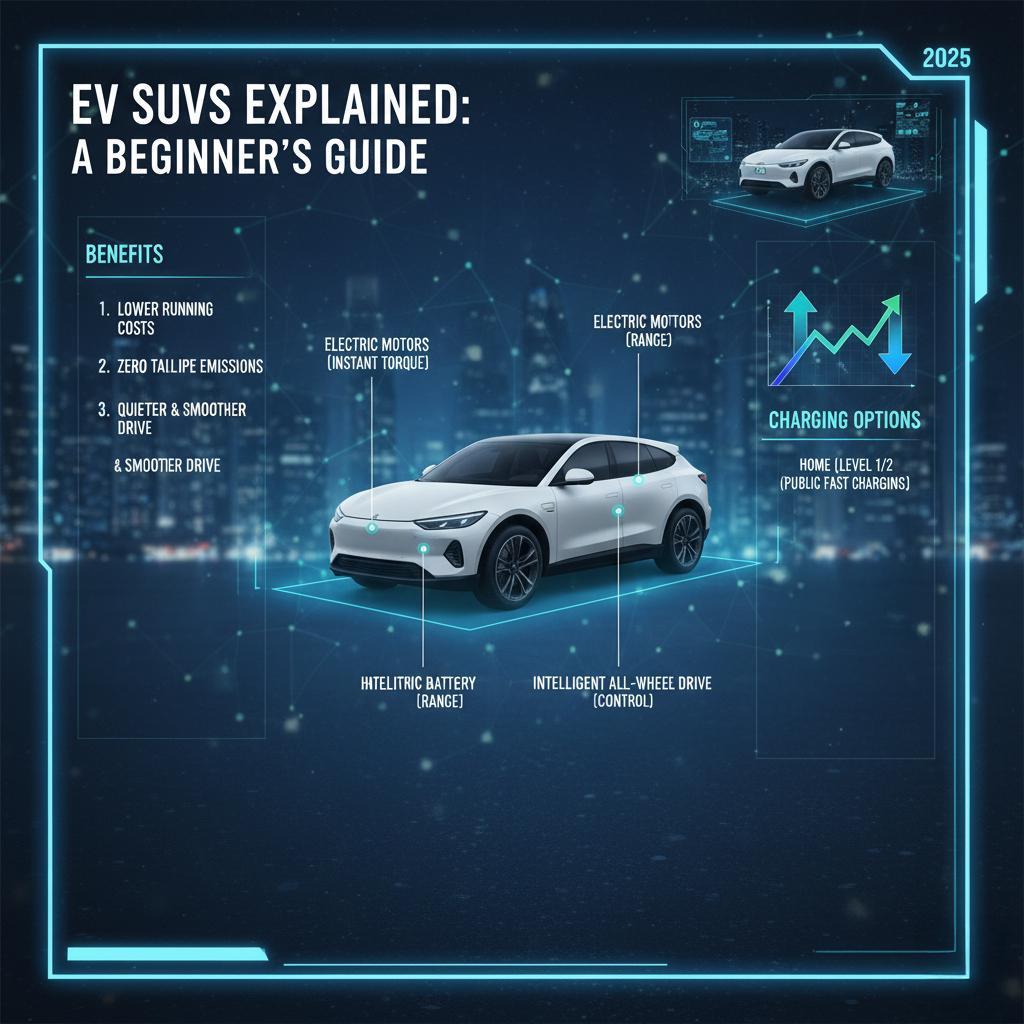
Battery pack (kWh): Think of kWh as the “size of the fuel tank.” Bigger kWh = more potential range, but also more weight.
-
Electric motor(s) (kW): Convert electricity to motion. One motor = RWD/FWD; two motors = AWD (great traction, extra power).
-
Inverter & power electronics: The “traffic control” for electricity—send power to the motors and recover energy while braking.
-
Onboard charger (kW): The hardware that determines how fast you can charge on Level 2 at home/public stations.
Range: how far can I go?
Modern EV SUVs commonly offer 220–330 miles on a full charge (real-world varies by speed, temperature, terrain, cargo, and wheels/tires).
Range basics:
-
Highway speeds reduce range more than city driving (less regen, more aero drag).
-
Cold weather can cut range by 15–35% (heating uses energy; preconditioning helps).
-
Towing & roof boxes increase drag/weight and reduce range—plan charging stops.
Pro tip: Shop by real-world range, not just the biggest number on the sticker. Look for owner tests and mixed-driving figures.
Charging: simple once you try it
Three common ways to charge:
-
Level 1 (120V home outlet)
-
~3–5 miles of range per hour.
-
Good for very low daily miles or occasional top-ups.
-
-
Level 2 (240V home or public)
-
~20–40+ miles of range per hour (depends on onboard charger kW).
-
Ideal for overnight charging at home or long parking stops in public.
-
-
DC Fast Charging (road trips)
-
10–80% in ~20–45 minutes, depending on vehicle and charger power (kW) and the car’s “charging curve.”
-
Best used when traveling; not usually needed for daily driving.
-
Key terms you’ll see:
-
kW vs. kWh: kW = power (charging speed or motor power). kWh = energy (battery size).
-
State of charge (SoC): Battery % full. Road-trip sweet spot is often charging between 10–80%.
-
Preconditioning: Warming/cooling the battery before fast charging to get the quickest speeds.
Costs: what you’ll actually spend
-
Electricity vs. gasoline: Home charging typically costs less per mile than fuel. Nighttime or off-peak rates can save more.
-
Maintenance: No oil changes; fewer fluids; brake wear is lower thanks to regenerative braking.
-
Insurance: Can be similar to a comparable gas SUV; varies by model and market.
-
Incentives: May exist from states, utilities, or local programs. Check what’s current where you live.
Driving feel: why EV SUVs feel “quick”
-
Instant torque: Electric motors deliver power immediately—great for merging and passing.
-
One-pedal driving: Strong regen can slow the car when you lift off the accelerator, reducing brake use and adding range.
-
Quiet cabin: Less vibration and noise compared with traditional engines.
Winter, towing, and cargo
-
Winter: Precondition the cabin and battery while plugged in; use heated seats/steering wheel for efficiency; keep tires properly inflated.
-
Towing: Many EV SUVs can tow, but range drops—plan extra charging stops. Check your model’s tow rating and cooling limits.
-
Cargo & roof boxes: Great utility, but added drag reduces efficiency at highway speeds.
Safety & tech
-
Low center of gravity: Batteries mounted in the floor help stability and rollover resistance.
-
Driver-assist features: Most EV SUVs include advanced safety tech (adaptive cruise, lane-keeping, blind-spot monitoring).
-
Battery safety: Packs have robust thermal management and protections; follow manufacturer charging/storage guidance.
What specs actually matter (and why)
When comparing models, focus on:
-
Real-world range (mixed driving, not just lab numbers)
-
DC fast-charge speed (peak kW and how long it sustains that speed)
-
Onboard charger (kW) for home Level-2 speed
-
Efficiency (kWh/100 mi or mi/kWh): lower kWh/100 mi = better
-
AWD vs. RWD (traction, performance, efficiency trade-offs)
-
Heat pump (improves cold-weather efficiency)
-
Towing rating & payload if you haul
-
Cargo volume and rear-seat space
-
Driver-assist & warranty (battery and drivetrain coverage)
Common myths—quick answers
-
“EVs are only for cities.” Many EV SUVs are road-trip capable with fast charging and 250–300+ miles of range.
-
“Batteries need replacing every few years.” Most packs are warranted 8 years / ~100,000 miles (varies by brand) and typically retain the majority of capacity well past that.
-
“Public charging is too hard.” Home Level-2 covers most daily needs; public fast charging is mainly for trips and is improving constantly.
How to test-drive an EV SUV (smart checklist)
-
Plan a real route: Include highway, city, a hill if possible, and parking.
-
Try one-pedal driving & regen settings.
-
Test fast-charge planning: Browse the car’s built-in trip planner and charging apps.
-
Assess comfort: Seats, visibility, headroom, rear-seat access, cargo lift-over height.
-
Check tech: Camera quality, lane-keeping smoothness, adaptive cruise behavior.
-
Home charging fit: Where will the cable reach? Is 240V feasible?
-
Cold-weather features: Heat pump, heated components, remote preconditioning.
Buyer profiles: which EV SUV fits you?
-
City/commuter: Prioritize efficiency, compact size, easy parking, and L2 home charging.
-
Family hauler: Rear-seat space, cargo volume, safety ratings, and driver-assist features.
-
Frequent road-tripper: Long real-world range, strong DC fast speeds, great route planner.
-
Outdoor/towing: AWD, higher tow rating, roof rails—plan for extra charging stops.
-
Budget-minded: Modest battery (still enough range), strong efficiency, affordable home L2 setup.
Quick glossary
-
BEV: Battery-electric vehicle (all-electric).
-
PHEV: Plug-in hybrid (electric + gas).
-
kW / kWh: Power vs. energy.
-
SoC: State of charge (%).
-
Regen: Regenerative braking (recovers energy when slowing).
-
Onboard charger: Determines Level-2 charging speed.
Bottom line
An EV SUV can be simpler to own, cheaper to run, and nicer to drive than many gas SUVs—especially if you can charge at home. Focus on real-world range, charging speed, and everyday usability (space, comfort, safety). Take a thorough test drive, confirm charging options that fit your life, and you’ll know which EV SUV is the right match.