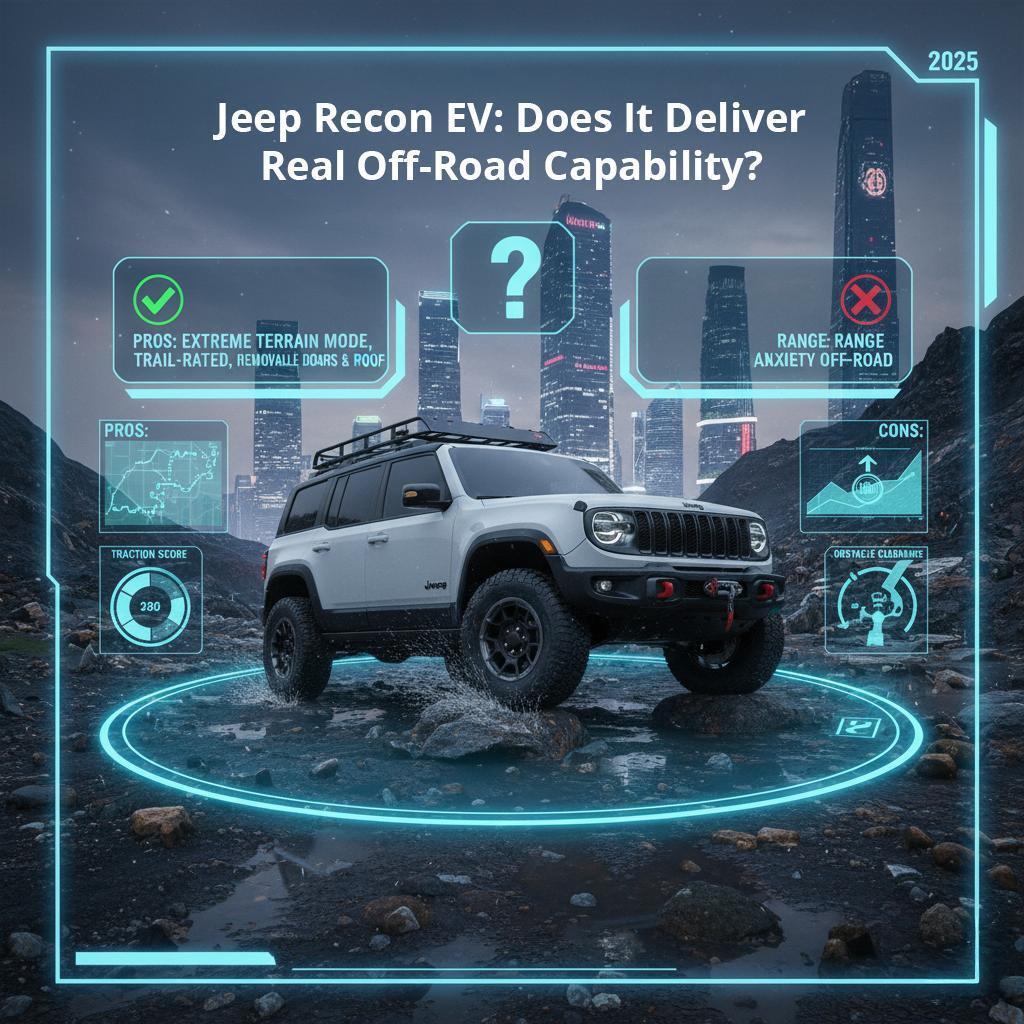
Quick take: It can—but only if Jeep ships it with true off-road hardware (lockers, tire clearance, travel, armor) and the software to match (precise crawl control, robust thermal management). EVs bring instant torque and fine control that’s excellent on rocks, but weight, range loss on trails, and charging logistics are real trade-offs.
What “real off-road” actually means (beyond marketing)
To compete with trail legends, an electric Jeep needs more than all-terrain tires and a cool mode name. Core requirements:
-
Traction hardware:
-
Front & rear locking differentials (physical or true e-lockers).
-
Low-range equivalent (gear reduction or software “crawl” that delivers very low wheel speed with high torque).
-
Sway-bar disconnect up front for articulation.
-
-
Chassis & geometry:
-
Ground clearance that still clears after fitting skid plates (aim 10–11+ inches as a practical minimum for moderate trails).
-
Approach / breakover / departure angles that don’t force constant spotting.
-
Wheel travel sufficient to keep tires planted instead of relying on traction control.
-
-
Protection & durability:
-
Full-length underbody armor for the battery, motor gearboxes, and cooling lines.
-
Sealed components and rated water-fording depth.
-
Recovery points (rated front/rear) and winch compatibility out of the box.
-
-
Control & cooling:
-
Rock-crawl / off-road modes with gentle pedal mapping and strong hill-descent control.
-
Thermal management that prevents power derates on slow, hot climbs.
-
EV strengths off road
-
Instant, precise torque: Feels like a perfectly geared low range. Picking your way over ledges becomes smoother and less jerky.
-
One-pedal finesse: Regenerative braking can act like engine braking on descents, adding confidence and control.
-
Sealed driveline: Fewer exposed components to drown or bash compared with traditional axles, driveshafts, and exhausts.
EV trade-offs you’ll feel on the trail
-
Mass: Batteries add weight. Heavier rigs push tires into obstacles, increase braking distances on descents, and stress suspension.
-
Range variability: Sand, mud, big tires, roof racks, and cold weather can carve 20–40% off rated range. Long, steep climbs are especially energy-hungry.
-
Charging logistics: DC fast chargers are near highways, not trailheads. You’ll plan loops, charge before you head out, and keep reserve for the return. Level-2 at cabins/camps is fine; portable generators defeat the purpose.
The hardware we’d want to see on a Recon EV
-
Dual-motor (or tri-motor) AWD with true locking behavior—not just brake-based torque vectoring.
-
Crawl control that delivers very low wheel speed without surging, plus a creep mode for micro-inputs.
-
Front sway-bar disconnect and long-travel suspension tuned for slow-speed articulation.
-
33–35 inch tire clearance stock (or via factory package) without rubbing at full articulation.
-
Comprehensive skid system: battery tub, motors/gearboxes, high-voltage cabling, coolant lines.
-
Rated water-fording and sealed connectors; venting designed for deep crossings.
-
Steering & brake tuning that stays consistent even when regen is maxed on descents.
-
Trail cameras (front/underbody) with washable lenses and high-contrast overlays.
How an electric “low range” can work
Traditional transfer cases multiply torque at low speed. EVs can mimic this with fixed gear reduction + precise motor control, delivering crawling torque at walking pace. What matters is:
-
Minimum controllable speed in rock-crawl mode (think: centimeters per second).
-
Fine pedal mapping so a millimeter of toe movement doesn’t jump a ledge.
-
Thermal stability—no power fade after 15 minutes of climbing in summer heat.
Battery & protection: the non-negotiables
-
Armor first: Skid plates must be structural, not thin dress-up panels. Look for multiple mounting points and replaceable sections.
-
Cooling loop protection: Lines and radiators need high mounting and guards.
-
Sealed pack & connectors: Deep puddles and silt kill electronics. Ratings and practical demonstrations matter more than claims.
Tires, wheels, and suspension (where capability lives)
-
Tires: Choose real all-terrains with reinforced sidewalls. EV weight punishes soft casings.
-
Wheels: Smaller diameter with more sidewall beats giant rims off road.
-
Springs & dampers: Valving must manage weight and slow-speed articulation without pogoing or harsh top-out.
-
Alignment & joints: Added mass + trail impacts = higher wear. Look for stout control-arm joints and serviceable components.
Real-world range on trails: plan like a pro
-
Expect less than highway range. Rock gardens, sand, and mud spike consumption.
-
Use regen on long descents, but don’t count on it to “refill” the battery meaningfully.
-
Start the trail with a buffer, and avoid arriving at a fast charger with a hot, low-SoC pack repeatedly—heat cycles add up.
Recovery & accessories
-
Rated front/rear recovery points and bumper designs that accept shackles or a winch mount.
-
On-board air helps with airing down and back up; EV compressors draw little range.
-
Roof loads: Mind dynamic load ratings; heavy racks and tents hurt range and raise the center of gravity.
Trail test checklist (bring this to your test drive)
-
Crawl a curb or ramp at a walking pace—check pedal smoothness and camera usefulness.
-
Articulation test: Cross-axle a speed bump diagonally—do wheels stay planted, or does traction control buzz constantly?
-
Steep hill start: Stop mid-slope, then restart—any surging, rollback, or power derate?
-
Downhill control: Try hill-descent + strong regen; look for stable, predictable speed without brake smell.
-
Underbody look: Inspect skid coverage and mounting; peek at cooling lines and HV cable routing.
-
Thermal sanity check: After a few low-speed climbs, see if power or charging speeds drop (signs of heat soak).
Who the Recon EV will suit—if the hardware lands
-
Trail weekenders who want clean, quiet crawling and are happy to plan charging.
-
Overlanders running moderate routes with access to Level-2 at base camps.
-
Daily drivers in snow/dirt regions who value winter traction and sealed driveline simplicity.
If your life is remote, multi-day trails with no power, an EV remains tricky—hybrids or range-extended setups still make sense there.
Verdict
It can be the real deal—if it ships with the right hardware and software: lockers that lock, genuine crawl control, big-tire clearance, serious armor, and thermal systems that don’t wilt. EV torque is magic on rocks, but mass and charging logistics are the price of admission. For buyers who wheel on weekends and charge in town, a properly equipped Recon EV could be the quiet, capable trail rig you’ve been waiting for.