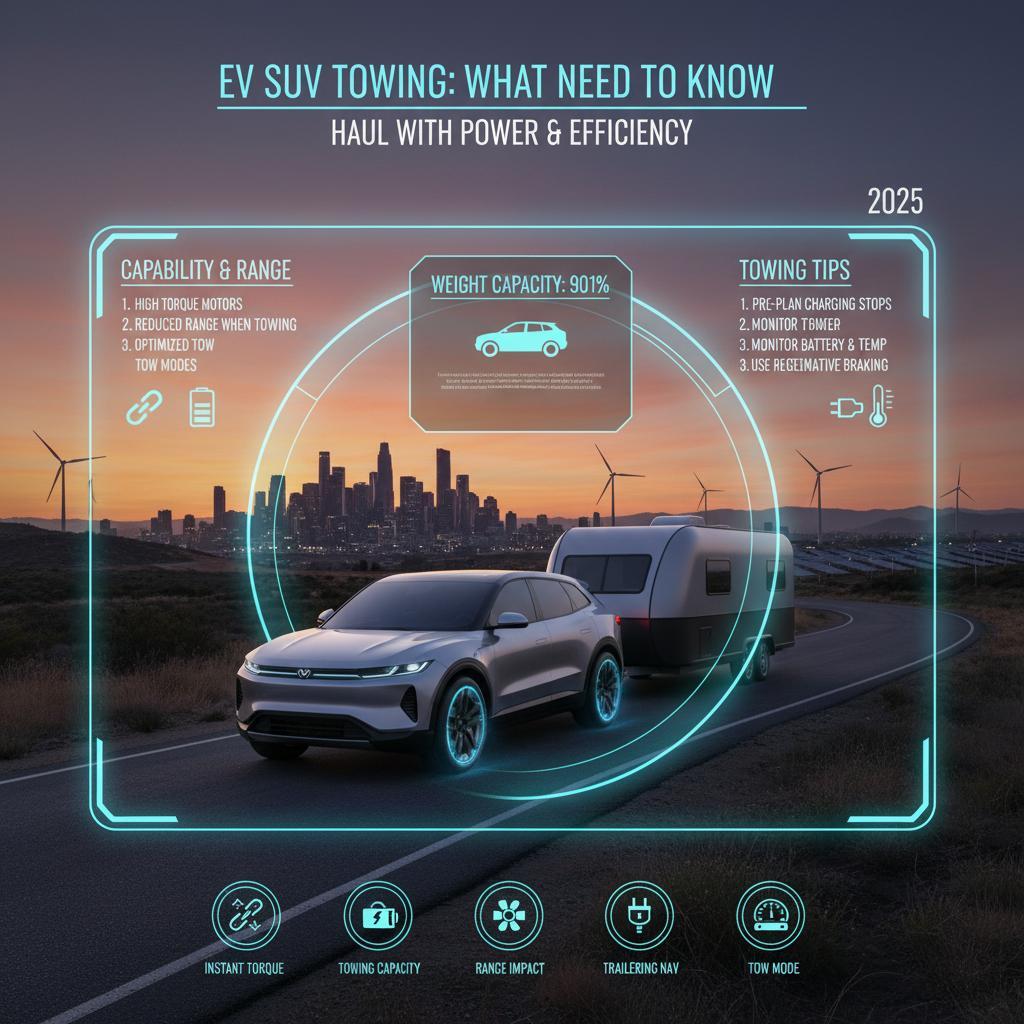
Quick take: EV SUVs tow well thanks to instant torque and stable weight distribution—but range drops (often 30–50%), charging logistics matter, and you must respect weight limits, tongue weight, and cooling. Plan routes around pull-through chargers, keep speeds sensible, and set the car up correctly.
Key towing terms (plain English)
-
Towing capacity: Max trailer weight the vehicle can pull.
-
GVWR / GAWR: Vehicle + payload limits (total / per axle).
-
GCWR (GCVWR): Vehicle + trailer combined max.
-
Payload: People + cargo + tongue weight (counts against payload).
-
Tongue weight: Downforce on the hitch—aim for 10–15% of trailer weight (travel trailers near 12–13%).
-
Hitch class:
-
Class II: up to ~3,500 lb / 1,600 kg
-
Class III: up to ~5,000 lb / 2,270 kg
-
Class IV: up to ~10,000 lb / 4,540 kg (check your vehicle rating)
-
How much range you’ll lose (and why)
-
Rule of thumb: Expect 30–50% range loss; boxy trailers at motorway speeds can exceed that.
-
Big factors: Speed (aero drag dominates), wind, hills, trailer frontal area, tires/pressure, roof racks.
-
Tip: If you must keep speed, choose the most aerodynamic trailer you can (rounded front, lower height).
Quick math example
-
Usable battery: 90 kWh; normal efficiency 3.0 mi/kWh (20 kWh/100 km).
-
Towing efficiency: 1.5–2.0 mi/kWh (31–41 kWh/100 km) → effective highway range roughly half.
-
On trips, plan 10–80% charging windows; e.g., 90 kWh × 70% = 63 kWh usable between stops → at 1.8 mi/kWh, that’s ~113 miles (~180 km) per leg.
Must-have hardware & settings
-
Factory tow package or certified retrofit: correct receiver, cooling, wiring (7-pin), and sometimes integrated brake controller.
-
Brake controller: Required for many trailers with electric brakes (region-specific laws). Wireless options exist if not factory-integrated.
-
Tow/Trailer mode: Adjusts throttle mapping, regen/braking logic, cooling, and stability systems.
-
Mirrors: Clip-on or factory tow mirrors for proper rear visibility.
-
Spare & tools: Many EVs skip a spare—pack a plug kit, compressor, and understand jack points.
Set-up & loading (do this right)
-
Weigh the combo: Know actual trailer weight and tongue weight; keep tongue 10–15%.
-
Balance the trailer: Heavy items low and forward of the axle; avoid tail-heavy sway.
-
Check payload math: Passengers + cargo + tongue must be ≤ vehicle payload.
-
Tire pressures: Set vehicle and trailer tires to tow specs (often higher).
-
Lights & brakes: Verify 7-pin wiring, brake controller gain, and trailer breakaway switch.
Driving techniques that save energy (and nerves)
-
Speed is everything: The difference between 110 km/h and 90 km/h can make or break your leg length.
-
Smooth inputs: Roll onto throttle; avoid surge that heats components.
-
Use the right lane & plan passes: Keep headwinds and grades in mind.
-
Regen with care: Some EVs reduce regen when a trailer is detected; rely on tow mode and proper brake controller settings for stable decel.
-
Watch temps: Many EVs show battery/drivetrain temperature—if you see limits, back off and cool.
Charging with a trailer (the trickiest part)
-
Favor pull-through sites: Easier than unhitching. If none, plan turnaround space or be ready to drop the trailer (use a wheel jack/dolly).
-
Arrive low, leave ~80%: Fastest charging sits between ~10–60%; taper toward 80%.
-
Precondition the battery: Use built-in trip planner so the pack is at the right temp on arrival.
-
Site etiquette: Park to keep other stalls accessible; if you must unhitch, do it swiftly and safely.
Heat management & maintenance
-
Cooling counts: Long, slow climbs + heat stress the pack and motors. Give the car time to cool if power tapers.
-
Service items: Follow intervals for battery coolant, check brake pads/rotors, and keep wheel bearings on the trailer greased and adjusted.
-
After trips: Inspect hitch hardware, wiring, tires, and skid/underbody for damage.
Legal & safety notes (regional differences apply)
-
Speed limits for towing may be lower in your region.
-
Trailer brakes often required above specific weights (e.g., 750–1,500 kg / 1,650–3,300 lb).
-
Breakaway cable, safety chains, and reflectors are mandatory.
-
Carry a fire extinguisher, triangles, gloves, and torch/headlamp.
What to look for when buying an EV SUV for towing
-
High, real tow rating with a sensible tongue weight allowance.
-
Strong thermal systems and a tow mode that manages regen and cooling.
-
Integrated brake controller and standard 7-pin wiring.
-
Air/self-leveling suspension (helps with squat, stability, and headlights aim).
-
Big battery + fast DC charging (ideally strong 10–80% times and a flat curve).
-
Trailer-friendly cameras (rear/side), trailer sway control, and route planning that includes chargers.
Tow-day checklist (save this)
Payload math done; tongue 10–15%
Tires set (vehicle + trailer)
Lights, brakes, breakaway tested
Mirrors adjusted; load secured
Tow mode on; brake controller gain set
Route includes pull-through or safe unhitch spots
Start with SoC buffer; plan 10–80% stops
Watch temps; slow down if power limits appear
Bottom line
EV SUVs can tow well—they’re stable, torquey, and confident. The trade-offs are range and charging logistics. Keep speeds moderate, nail the setup and weight math, and plan pull-through-friendly routes. Do that, and towing with an EV SUV becomes predictable—and surprisingly relaxing.