
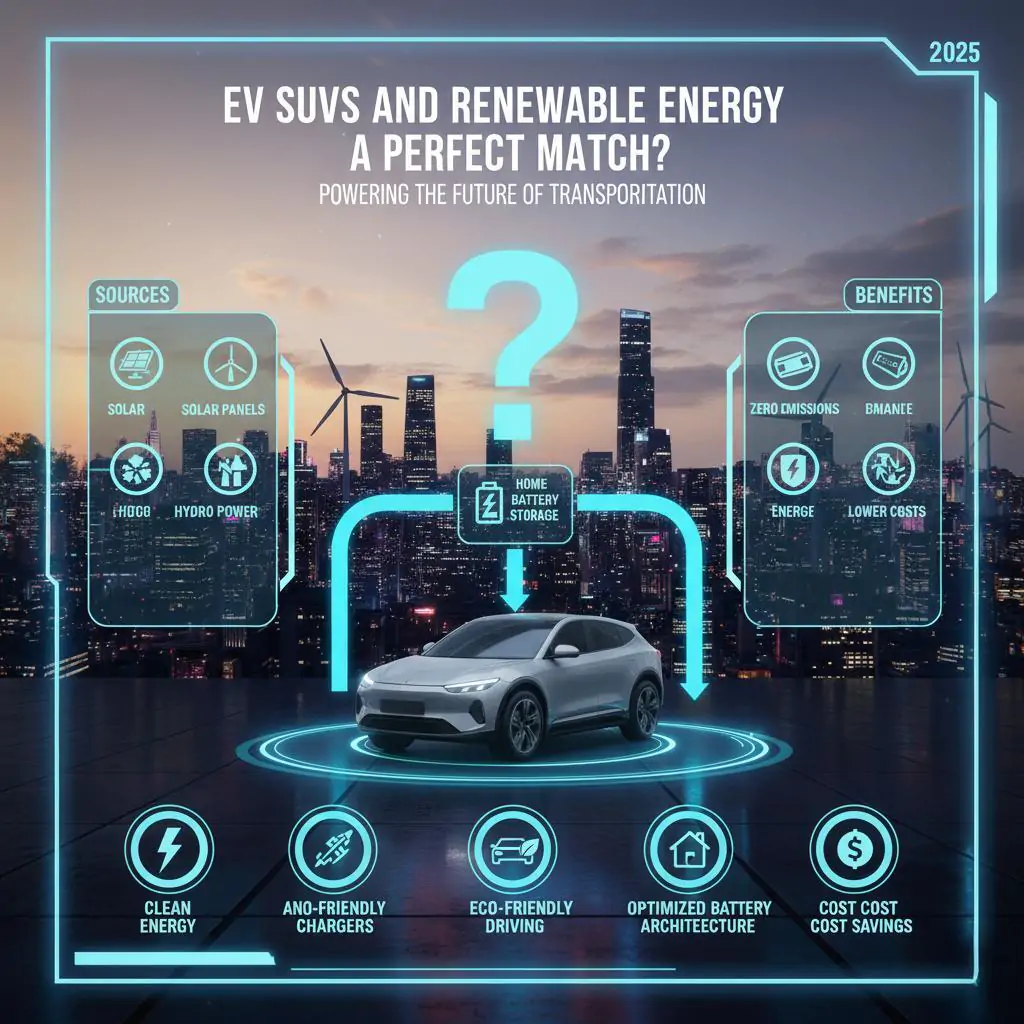
Quick take: Yes—EV SUVs pair naturally with renewables. They’re large, flexible electrical loads you can shift to sunny or windy hours, store energy (with bidirectional tech), and slash running costs with smart tariffs. Done right, you’ll drive cleaner, cheaper, and place less stress on the grid.
Why EVs + Renewables Fit So Well
-
Flexible load: Most cars sit parked 20+ hours/day. That means charging can happen when clean power is plentiful—midday solar or overnight wind.
-
Bigger batteries help the grid: An EV SUV’s pack dwarfs a home battery. With the right hardware, it can soak up excess solar and even stabilize your home during outages (V2H) or support the grid (V2G).
-
Lower lifetime emissions: Charging from a cleaner mix reduces well-to-wheel CO₂, and it keeps improving as the grid gets greener.
Home Solar + EV: How the Synergy Works
-
Self-consumption first: Set your charger to prefer midday (when rooftop PV peaks). You’ll “eat your own solar” instead of exporting for pennies.
-
Smart charging: Use a wallbox/app that follows time-of-use (TOU) prices or solar surplus in real time.
-
Precondition while plugged in: Cool/heat the cabin on solar power before departure to save battery energy on the road.
-
Home battery optional: A 10–20 kWh stationary battery smooths clouds and evening charging; not mandatory, but great if you want nighttime solar driving.
Vehicle-to-Home (V2H), V2L, and V2G—What’s What?
-
V2L (Vehicle-to-Load): Your EV provides standard AC outlets (handy for tools, camping, or emergency fridge power).
-
V2H (Vehicle-to-Home): The car powers your house via a compatible bidirectional charger + transfer gear—great during outages or peak prices.
-
V2G (Vehicle-to-Grid): Your EV exports energy to the grid for payment or bill credits (requires utility + hardware support).
Note: Compatibility (car + charger + local rules) is essential—check your model’s bidirectional support and approved chargers.
Sizing: How Much Solar Do You Need for Driving?
Use simple math:
Daily EV energy (kWh) = daily miles × efficiency (kWh/mi)
Typical EV SUV efficiency: ~0.30–0.36 kWh/mi (18–22 kWh/100 km).
Example: 40 miles/day × 0.33 ≈ 13 kWh/day just for driving.
PV rough idea (very location dependent):
Average annual production can be ~3–5 kWh per kW of PV per day in many temperate regions.
To cover ~13 kWh/day, you might plan 3–5 kW of PV for driving alone, more if you also want to offset household loads. (Local solar yield varies—use a local calculator or installer estimate.)
Home battery thought: If you want evening charging from solar, size a battery that comfortably covers a typical one-night top-up (e.g., 8–15 kWh), plus a cushion for household loads.
Apartments & Shared Buildings
No roof? You still have options:
-
Workplace solar charging or community solar subscriptions.
-
Smart load sharing on shared EVSEs so everyone charges during cleaner, cheaper windows.
-
Night wind tariffs: Off-peak rates often align with cleaner generation and lower demand.
Cost Wins You’ll Actually Feel
-
Time-of-use scheduling: Charge when prices dip (midday or overnight).
-
Solar surplus mode: Prioritize free kWh from your roof before buying from the grid.
-
Right-size your EVSE: A 40–48 A (≈9.6–11.5 kW) unit (NA) or 7.4–11 kW (EU) easily replenishes daily miles; faster isn’t always necessary.
-
Wheels/tires matter: Modest wheels and efficient tires improve range—fewer kWh bought, more miles per sunbeam.
Winter & Seasonal Reality
-
Cold cuts range. Counter with preconditioning while plugged in, seat/steering heat, proper tire pressure, and leaving earlier to stay efficient.
-
Short days: Let smart scheduling chase the best window (midday sun or off-peak night rates).
-
Roof snow: Clear panels promptly if you rely on PV for charging.
Common Myths (Fast Answers)
-
“You need a huge solar array to drive electric.”
Not for daily commuting. Even modest PV can cover typical weekday miles over a year. -
“If it’s cloudy, EV + solar doesn’t work.”
Clouds reduce output, not eliminate it. Smart TOU charging still cuts costs and emissions. -
“V2G will kill my battery.”
Sensible limits and modern battery management keep degradation modest. Participation should be optional and controlled.
Your Setup—A Practical Blueprint
-
Charger: Choose a smart Level-2 wallbox with TOU scheduling and (ideally) a solar surplus mode.
-
Tariff: Switch to a time-of-use plan (or dynamic pricing) so software can target cheap/clean hours.
-
Solar (if applicable): Install PV where feasible; plan cable runs so the wallbox can see solar/battery data.
-
Battery (optional): Add a home battery if you want evening solar miles or outage resilience.
-
Vehicle settings: Set a daily charge limit (e.g., 70–80%), schedule charging to finish before departure, and enable preconditioning.
-
Future-proofing: If you care about V2H/V2G later, pick hardware that’s bidirectional-ready (car + charger + electrical panel provisions).
Quick Checklists
Daily charging routine
Charge limit set (≈80% daily)
Schedule aligns with sunny hours or off-peak
Precondition while plugged in
Keep tires at spec; remove unused roof racks
Install must-haves
Correct breaker/wire for continuous load
Weather-rated enclosure (outdoor installs)
Cable long enough for all parking orientations
Load sharing or dynamic limit if panel is tight
Bottom line
EV SUVs and renewables do belong together. Let software chase sunny hours and cheap tariffs, consider PV (and optionally a home battery) to drive on your own electrons, and, if your model allows, explore bidirectional uses for backup and grid support. Set it up once and your daily routine becomes simple: plug in, schedule smartly, and roll on clean power.