
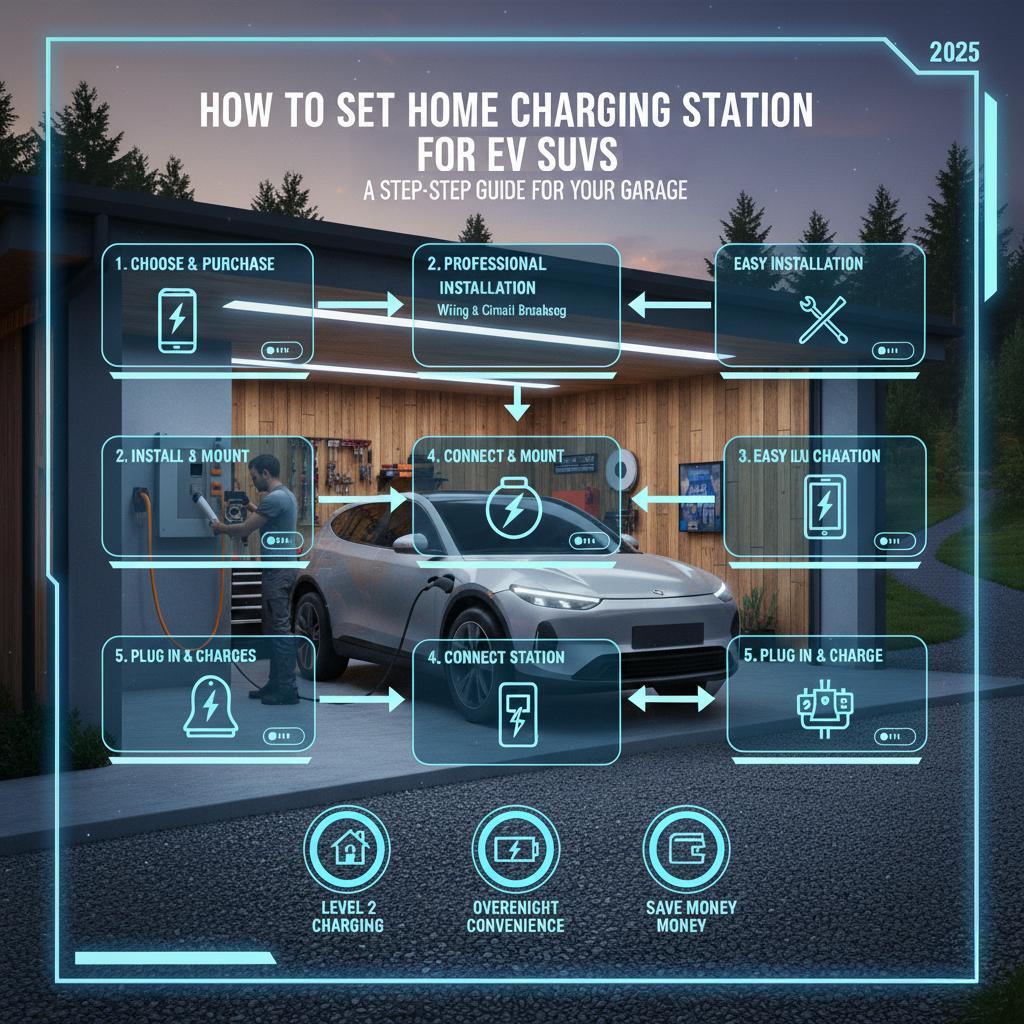
Quick take: Aim for a Level-2 wall charger (home AC) sized to your panel:
-
North America: 40–48 A EVSE on a 50–60 A circuit (240 V).
-
Europe/UK: 7.4 kW (32 A single-phase) or 11 kW (16 A 3-phase) if available.
Pick a 24–25 ft (7–7.5 m) cable, outdoor-rated enclosure, and smart features you’ll actually use (scheduling, load management, solar support). Have a licensed electrician install and test it.
Step-by-step: from idea to first charge
-
Define your need
-
Daily driving: <50 mi / 80 km? Almost any Level-2 is fine.
-
Big-battery SUV, frequent miles? Choose the highest practical home power (see sizing below).
-
-
Check your electrical panel
-
NA: Look for spare breaker spaces and service size (e.g., 100 A vs 200 A).
-
EU/UK: Note single- vs 3-phase supply and main fuse rating.
-
-
Pick your connector
-
NA: NACS (rapidly becoming standard) or J1772. A “universal” unit covers both.
-
EU/UK: Type 2 (Mennekes) is standard.
-
-
Choose amperage / power
-
NA rule of thumb (continuous load 125%):
-
48 A EVSE → 60 A breaker (≈11.5 kW)
-
40 A EVSE → 50 A breaker (≈9.6 kW)
-
32 A EVSE → 40 A breaker (≈7.7 kW)
-
-
EU/UK:
-
7.4 kW = 32 A single-phase
-
11 kW = 16 A 3-phase (many cars’ onboard chargers max here)
-
22 kW = 32 A 3-phase (vehicle-limited; nice for future-proofing)
-
-
-
Decide hardwire vs. plug-in
-
Hardwire = clean install, max output (e.g., 48 A NA).
-
Plug-in (NA 14-50/6-50) = flexible, typically capped at 40 A.
-
-
Pick features that matter
-
App scheduling (off-peak rates), usage logs
-
Load sharing (two EVs, one circuit)
-
Dynamic load management (prevents panel overload)
-
Solar surplus charging (if you have PV)
-
Access control (lock/QR/RFID)
-
-
Placement & cable plan
-
Mount near the charge port to avoid stretching.
-
Get 24–25 ft / 7–7.5 m cable for parking flexibility.
-
Outdoor install? Choose NEMA 3R/4 / IP54+ enclosure and UV-rated cable.
-
-
Permits & installation
-
Pull permits if required. Use correct breaker size, wire gauge, and RCD/GFCI per local code.
-
EU/UK: RCD/RCBO selection (Type A + 6 mA DC detection or Type B as required), PME earthing considerations.
-
-
Commissioning
-
Set max current in the charger/app to match the circuit.
-
Test charge, confirm no nuisance trips, verify the cable reaches all parking positions.
-
-
Optimize
-
Program off-peak schedule.
-
Enable preconditioning in your car before departures.
-
If you add a second EV, enable load/power sharing.
How big a charger do you really need?
Simple maths:
-
Energy to add ≈ daily miles × (your SUV’s kWh/mi).
-
Typical EV SUV efficiency: 0.30–0.36 kWh/mi (18–22 kWh/100 km).
Examples (overnight refill, ~8 hours):
-
40 mi / 65 km day × 0.33 kWh/mi ≈ 13 kWh → even 3.6–7.4 kW is plenty.
-
100 mi / 160 km day × 0.33 kWh/mi ≈ 33 kWh → 7.4–11 kW makes it easy.
Big-battery road-trippers benefit from 11 kW (EU) or 48 A ≈11.5 kW (NA) to recover faster between days.
Special cases
-
Panel-limited homes (NA): Use smart load management or a UL-listed dryer-outlet splitter; set EVSE to 24 A on 30 A circuits.
-
Apartments/condos: You may need HOA/landlord approval, a dedicated meter or load-sharing hub, and access control for billing.
-
Cold climates: Prefer units with robust cables, plan for slightly higher nightly energy, and use cabin/pack preconditioning while plugged in.
-
Two EVs: Choose chargers that share power on one feed or install a second circuit if capacity allows.
Safety & code essentials (checklist)
-
Correct breaker and wire gauge for continuous load.
-
RCD/GFCI protection per local code (and DC leakage protection in EU/UK).
-
Proper earthing/grounding and bonding.
-
Drip loop, strain relief, and weather-tight fittings outdoors.
-
Label the circuit; keep a dedicated EVSE circuit when possible.
Cost & timeline (typical)
-
Hardware:
-
NA 40–48 A smart EVSE: mid- to high-hundreds (USD).
-
EU/UK 7.4–11 kW smart wallbox: similar range (EUR/GBP).
-
-
Install:
-
Short run/simple: modest.
-
Long run/panel upgrade/groundworks: higher.
Most installs complete in half a day to a day once scheduled.
-
Common pitfalls to avoid
-
Oversizing wheels/tires on the SUV then expecting the same range.
-
Mounting too far from the charge port (buy the longer cable!).
-
Skipping permits or the wrong RCD/GFCI type.
-
Forgetting to cap charger amperage to the circuit rating in the app.
-
Not using off-peak schedules—you’ll pay more than necessary.
Quick buyer picks (plain English)
-
“Works with anything” + future-proof (NA): Universal/NACS wall unit, 48 A hardwired, 24–25 ft cable, load sharing.
-
“Data + solar” people: Charger that supports energy monitoring and solar-excess mode.
-
“Just charge, no cloud”: Rugged, UL/CE-listed unit with simple dip-switch current settings.
Bottom line
Size the charger to your panel and driving, pick a weather-rated unit with scheduling and load management, and have it professionally installed. A right-sized Level-2 setup turns EV-SUV ownership into a simple routine: plug in at night, leave full every morning.