
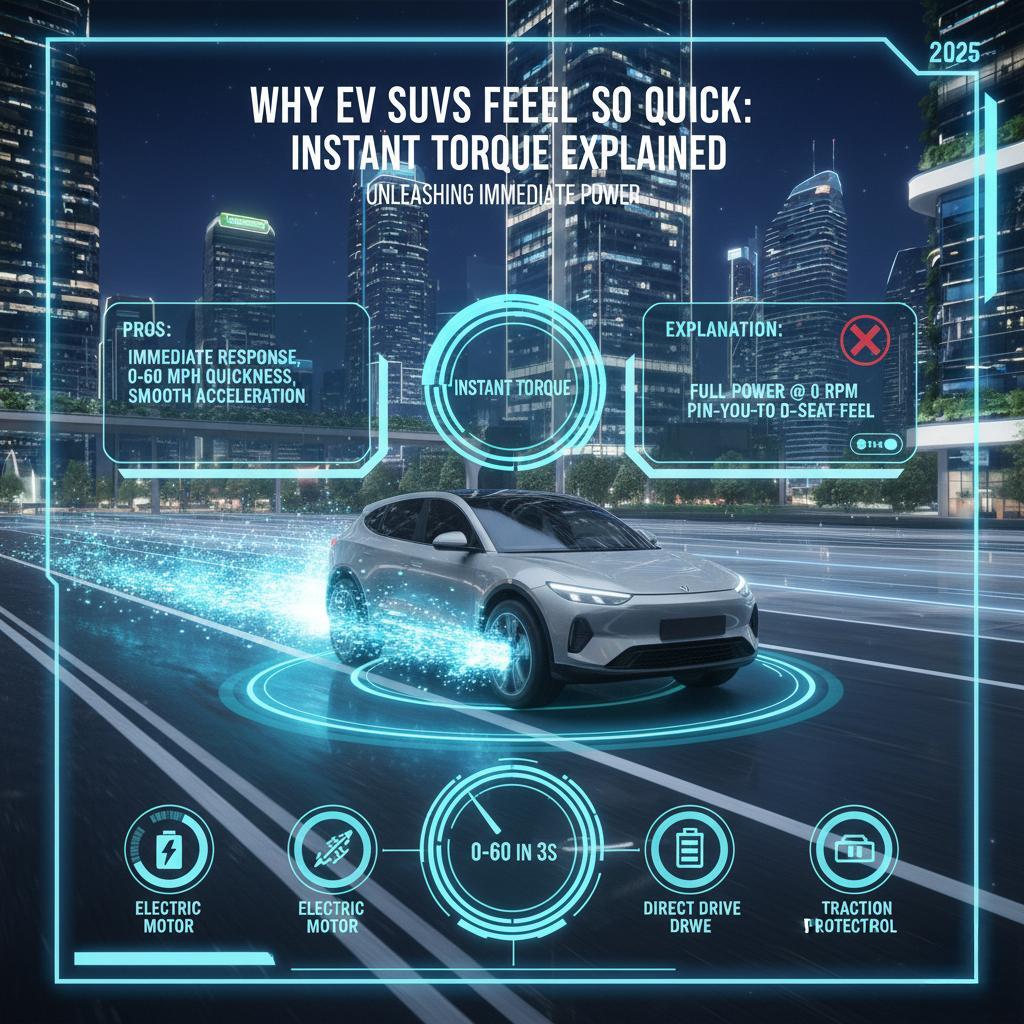
Quick take: EV SUVs feel fast because their motors deliver max torque the instant you press the pedal, with no shifting delays and precise electronic control. That rocket-like 0–30 mph (0–50 km/h) surge is where the “whoa!” lives—even if some gas performance SUVs can still win in long, high-speed pulls.
Torque vs. Horsepower (plain English)
-
Torque is the twisting force that gets you moving.
-
Horsepower is how quickly torque is applied over time (power = torque × rpm).
-
EVs produce peak torque from 0 rpm, so they launch hard. Gas engines must rev up and shift before delivering peak thrust.
In SI units: Power (kW) = Torque (N·m) × rpm / 9549.
EVs start at high torque and ramp rpm instantly—so power arrives quickly and smoothly.
Why EVs Hit So Hard Off the Line
-
No gearbox delays
Single-speed reduction gearing means no upshift lag or torque interruptions. You get one clean, continuous pull. -
Instant motor response
Inverters modulate current in milliseconds, mapping your right foot to motor torque with far less delay than fuel+air combustion can manage. -
Perfect low-speed torque curve
Electric motors naturally deliver maximum torque at low rpm; great for launches, merging, and short gaps in traffic. -
Smart traction from the start
With dual motors, the car can vector torque front/rear to keep all four contact patches working—less wheelspin, more go.
Why the Rush Eases at Higher Speeds
-
Power—not torque—rules above ~50–60 mph (80–100 km/h). Aero drag climbs quickly, so sustained pull depends on total horsepower and battery output.
-
Torque tapers with rpm. As motor speed rises, available torque usually falls; software protects the hardware and battery.
-
Thermal & state-of-charge (SoC) limits. A cold or low-SoC pack may cap peak power; repeated hard pulls heat things up and can reduce output temporarily.
The Role of Weight (and Why EVs Still Feel Quick)
EV SUVs are heavy (big batteries), which hurts physics—but they still feel quick because:
-
Low center of gravity (battery in the floor) keeps the body planted—less squat and pitch, more confidence.
-
Immediate torque overcomes inertia at neighborhood speeds.
-
Fine pedal mapping makes response crisp without lurching.
Heavy mass shows up most in braking distances, tire wear, and sustained high-speed acceleration, not in that first punch off the line.
Pedal Mapping, Modes, and “Seat-of-Pants” Speed
-
Drive modes (Eco/Normal/Sport) change pedal sensitivity and how aggressively the inverter feeds current.
-
One-pedal driving increases regeneration, adding a taut, responsive feel in traffic.
-
Traction/stability tuning determines how much slip is allowed—snappier in Sport, calmer in Comfort.
Two EVs with similar specs can feel different just from software calibration.
AWD Dual-Motor Advantage
-
Launch traction: Two motors share the work; it’s harder to overwhelm the front or rear tires.
-
Torque vectoring: Shifting torque between axles stabilizes the car and translates power into forward motion.
-
Efficiency tricks: Some systems “sleep” one motor when cruising, waking it instantly for bursts.
Myths vs. Reality
-
“EVs always have full torque at all speeds.”
Peak torque is at low rpm; it tapers at higher rpm to protect the motor and battery. -
“Single-speed kills top-end.”
It’s a trade-off: brilliant low-to-mid response, adequate top-end for SUVs. Multi-speed boxes are rare because added complexity often isn’t worth it for this class. -
“If it feels quick, it is the quickest.”
Perception ≠ stopwatch. EVs wow from 0–30 mph, but high-power gas rivals can pull harder above highway speeds.
How to Feel Your EV SUV at Its Quickest (Safely)
-
Use the right mode: Sport/Performance for max response; Eco dulls the pedal.
-
Mind SoC & temps: Keep SoC ~60–80% for spirited drives; precondition the battery in cold weather if your car supports it.
-
Right tires, right pressure: Warm, quality tires grip better and translate torque into acceleration.
-
Travel light & smart wheels: Extra mass and oversized wheels blunt response and efficiency.
-
Smooth inputs: EVs reward finesse—steady pedal gives you maximum, controllable thrust.
Test-Drive Checklist (5 Minutes That Matter)
-
0–50 km/h pulls: Feel the initial surge and how cleanly it builds.
-
Rolling merge (50–100 km/h): Sample passing response—this shows power, not just torque.
-
Mode swap: Toggle Eco/Normal/Sport and compare pedal mapping and drivetrain eagerness.
-
One-pedal in traffic: Check how naturally the car transitions from push to regen.
-
Rough pavement: Note how planted it feels—low CG should keep it composed.
Bottom Line
EV SUVs feel so quick because electric motors serve torque immediately, the single-speed driveline never interrupts thrust, and software keeps traction optimized. That translates into addictive, effortless 0–30 mph punch and confident city-to-suburb driving. At higher speeds, the story shifts to total power, aerodynamics, and temperature/SoC, but for everyday use, instant torque is the secret sauce behind that unmistakable EV “snap.”