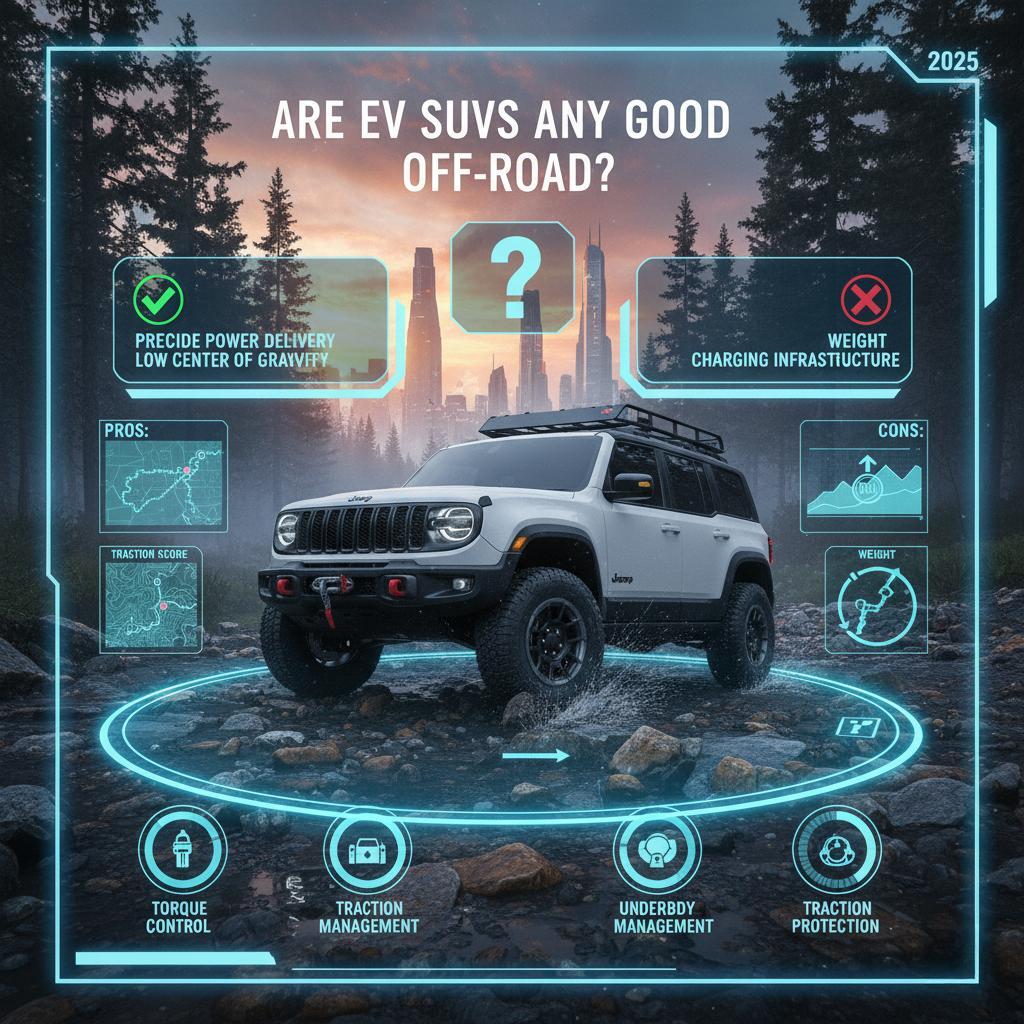
Quick take: Yes—with the right hardware. EVs bring instant, precise torque and great low-speed control that feel tailor-made for rocks and ruts. The trade-offs are weight, range loss on trails, and charging logistics. If you wheel near towns or basecamps (with Level-2), a well-equipped EV SUV can be excellent. For remote, multi-day routes without power, planning gets harder.
Where EVs Shine Off-Road
-
Instant torque & pedal finesse: Smooth crawl over ledges without revs or clutch work.
-
One-pedal control: Strong regeneration mimics engine braking on descents.
-
Sealed driveline: Fewer exposed parts (no exhaust, fewer fluids) means fewer snag points and better water resilience.
-
Low center of gravity: Battery in the floor = planted feel on sidehills.
The Trade-Offs You’ll Notice
-
Mass: Battery weight loads tires/suspension and lengthens braking on descents.
-
Range variability: Sand, mud, climbs, big tires, roof racks, cold weather can cut range 20–40% vs. brochure numbers.
-
Charging access: DC fast chargers cluster near highways; trailheads rarely have them. Level-2 at cabins/camps is ideal—but not guaranteed.
-
Thermal management: Long, slow, hot climbs can heat-soak batteries/motors and reduce power until temps drop.
Hardware That Matters (More Than Horsepower)
-
Traction aids
-
Locking differentials (front/rear e-lockers or true software locks), not just brake-based “limited slip.”
-
Low-range equivalent: Ultra-low crawl mode or fixed gear reduction that allows centimeters-per-second control.
-
Sway-bar disconnect up front for articulation.
-
-
Geometry & suspension
-
Ground clearance: Aim for ~10–11 in (25–28 cm) usable after armor is fitted.
-
Approach / breakover / departure angles that don’t force constant spotting.
-
Wheel travel: Keeps tires planted so traction control isn’t doing all the work.
-
-
Protection
-
Full-length skid plates: Battery tub, motor/gearboxes, high-voltage cabling, cooling lines.
-
Sealing & fording: Protected connectors and a stated wading depth.
-
Recovery points: Rated front and rear; bumper/winch compatibility.
-
-
Control & cooling
-
Rock-crawl mapping: Gentle throttle, creep mode, and fine hill-descent control.
-
Robust thermal systems: Maintain power on long climbs and recover quickly for charging.
-
Tires, Wheels, and Setup
-
All-terrain tires with reinforced sidewalls—EV weight punishes soft casings.
-
Moderate wheel sizes (more sidewall = grip, protection, comfort).
-
Avoid heavy roof loads unless needed; they hurt range and raise the center of gravity.
-
Mild lifts: Help clearance but can affect aero, efficiency, and sensor angles—choose quality kits and get an alignment.
Range on Trails: Plan Like a Pro
-
Expect less than highway range on rocks, sand, and climbs.
-
Start high, finish safe: Begin the trail with a buffer; don’t end the day at 0%.
-
Regen is a helper, not a refueler: Long descents add a little back but won’t “charge the pack.”
-
Weather matters: Cold reduces range; precondition while plugged in and use seat/steering heat to save energy.
Charging Strategy for Off-Road Days
-
Basecamp Level-2 (240V) is the sweet spot—top up overnight, wheel by day.
-
DC fast before/after trails if the route passes a highway corridor.
-
Destination charging: Lodges, cabins, RV parks, and some parks/campgrounds offer Level-2; call ahead.
-
Portable generators defeat the point and add complexity—use as last resort only where rules allow.
Driving Techniques (EV-Specific)
-
Feather the pedal: Let the motor’s precision do the work; avoid “sawing” the throttle.
-
Use one-pedal + hill-descent: Stable, low-speed control on steep downs.
-
Select proper mode early: Rock/snow/mud modes adjust mapping and traction logic.
-
Watch temps: If power tapers, pause to cool—open hood/frunk if the manual allows airflow; avoid blocking vents with mud.
Recovery & Safety
-
Rated shackles/points only—no tow-ball pulls.
-
On-board air is great for airing down/up; tire pressure is your #1 traction tool.
-
Underbody checks after rocky sections; look for dings on armor and fluid line guards.
-
Electrical safety: Follow the manual’s guidance for water crossings and lifting/jacking points.
Trail Test Checklist (Bring This)
-
Creep test: Crawl a curb/rock at walking pace—no surging or lurching.
-
Articulation: Cross a speed bump diagonally—do wheels stay planted?
-
Steep restart: Stop on an incline and go again—smooth pullaway, no rollback.
-
Downhill control: One-pedal + hill-descent at a steady, slow pace.
-
Thermal sanity: After 10–15 minutes of slow climbing, check for power reduction.
-
Armor inspection: Look under the vehicle—continuous skid coverage? Exposed lines/cables?
-
Charging reality: Confirm where you’ll top up post-trail (Level-2 or DC) and the time window.
So…Are EV SUVs Any Good Off-Road?
Absolutely—when they’re equipped for it. EV torque and pedal precision make technical crawling easier and quieter than many gas rigs. If your adventures start and end near civilization (or a reliable Level-2), a well-armored, locker-equipped EV SUV can be a superb trail partner. If your trips are remote, multi-day routes with no power, you’ll need meticulous planning—or a different powertrain. The key is matching the hardware and charging plan to the trails you actually drive.