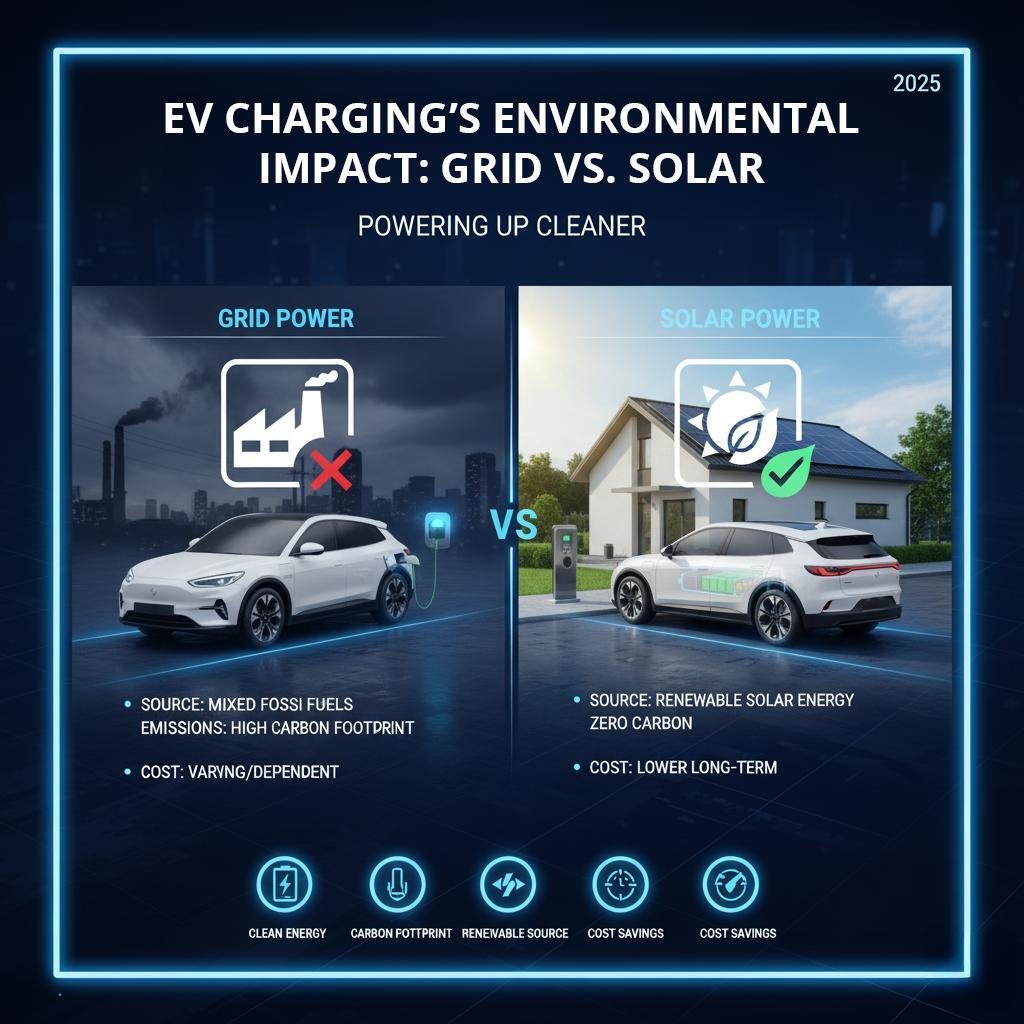
Quick take: Charging an EV SUV on today’s grid is usually cleaner than burning fuel, and it keeps getting cleaner as the grid adds renewables. Charging from rooftop solar can cut emissions further—especially when you charge while the sun’s out or store surplus in a home battery for evening top-ups. The biggest wins come from when you charge (timing) and how you source electricity (solar/self-consumption vs. grid mix).
How EV charging turns into emissions (simple math)
-
Energy use: Your EV SUV might average 18–24 kWh/100 km (0.18–0.24 kWh/km).
-
Grid impact: Multiply your EV’s kWh by your electricity carbon intensity (gCO₂/kWh).
-
Per-km CO₂ = (kWh/km) × (gCO₂/kWh)
-
-
Solar impact: Rooftop solar used directly is near-zero operational CO₂ (panels have embodied emissions from manufacturing, but they amortize over years of output).
Tip: Ask your utility for a time-of-use (TOU) carbon or generation mix chart. The “cleanest window” is often midday (solar-heavy) or overnight (wind-heavy), depending on where you live.
Grid charging: cleaner than you think, and getting cleaner
-
The grid is not one number. Carbon intensity changes hourly with sun, wind, demand, and imports.
-
Average vs. marginal:
-
Average tells you the day’s overall cleanliness.
-
Marginal tells you what extra generator turns on for your charging. Target clean marginal windows (sunny/windy periods).
-
-
Practical win: Shift most home charging to off-peak clean hours. It lowers both cost and emissions.
Solar charging: best when you consume your own sun
-
Self-consumption beats export. Charging midday from your roof keeps electrons in-house (minimal losses, minimal grid strain).
-
Season & weather matter: Short winter days and clouds reduce output—pair solar with smart scheduling and, if needed, a home battery.
-
Embodied emissions payback: Typical rooftop PV “repays” its manufacturing footprint in a few years; after that, it’s mostly clean miles.
Home battery + EV: great for evenings, with nuance
-
Why add a battery? Store midday solar to charge at night, ride out outages, and avoid dirty/expensive peaks.
-
Reality check: Batteries have round-trip losses (often 10–15%). Set your charger to finish near departure and use solar surplus modes to minimize losses.
Community solar & green tariffs (no roof required)
-
Community solar: Subscribe to a local array—offsets your usage without installing panels.
-
Green tariffs/renewable plans: Utilities or suppliers can match your consumption with renewable generation, often bundled with TOU pricing.
A simple planner for low-carbon charging
-
Find your clean windows. Check your utility’s TOU and (if available) carbon-intensity graphs.
-
Schedule charging to finish just before you leave during those windows.
-
Use solar surplus mode (many wallboxes support it) so your EV soaks up excess PV first.
-
Keep a daily limit (e.g., 70–80% SoC) and save 100% for trip days.
-
Precondition while plugged in (heat/cool the cabin using grid/solar, not the battery).
Real-world scenarios (what to do)
-
You have rooftop solar, no battery:
-
Charge midday (work-from-home or lunchtime stop).
-
If you’re away, schedule a late-morning to afternoon session on return.
-
-
You have solar + battery:
-
Store sun at midday; top up overnight from the battery.
-
Keep some battery reserve for morning preconditioning and peak shaving.
-
-
Apartment or no solar:
-
Use off-peak night (often windier, cleaner, cheaper).
-
Consider a green tariff or community solar subscription.
-
-
Cold winters:
-
Precondition on the cord; use seat/steering heat to cut energy draw.
-
Expect slightly higher kWh/100 km; timing matters even more.
-
Myths vs. reality
-
“If my grid burns fossil fuels, EVs aren’t cleaner.”
Even on fossil-heavy grids, EVs typically beat comparable gas SUVs over the full lifetime, and the gap widens as the grid decarbonizes. -
“Solar must cover every km or it’s pointless.”
Not true. Partial solar coverage plus smart timing still slashes emissions and costs. -
“Batteries degrade fast if I use V2H/V2G.”
Sensible, managed cycles with conservative limits are designed to be gentle; participation should be opt-in.
Quick setup checklist (save this)
Smart Level-2 charger with TOU scheduling and solar surplus mode
Charge limit set (≈80% for daily use)
Finish-by schedule aligned to clean/cheap hours
Preconditioning enabled while plugged in
If solar: midday charge window; consider home battery if evenings dominate
If no solar: enroll in green tariff/community solar; prioritize off-peak windows
Bottom line
-
Grid charging is already cleaner than fueling a combustion SUV in most places—and it keeps improving.
-
Rooftop solar (especially with midday self-consumption) drives emissions even lower.
-
The biggest lever is timing: let your EV charge when the electricity is cleanest and cheapest. Do that, and your EV SUV’s footprint shrinks with every software-scheduled session.