
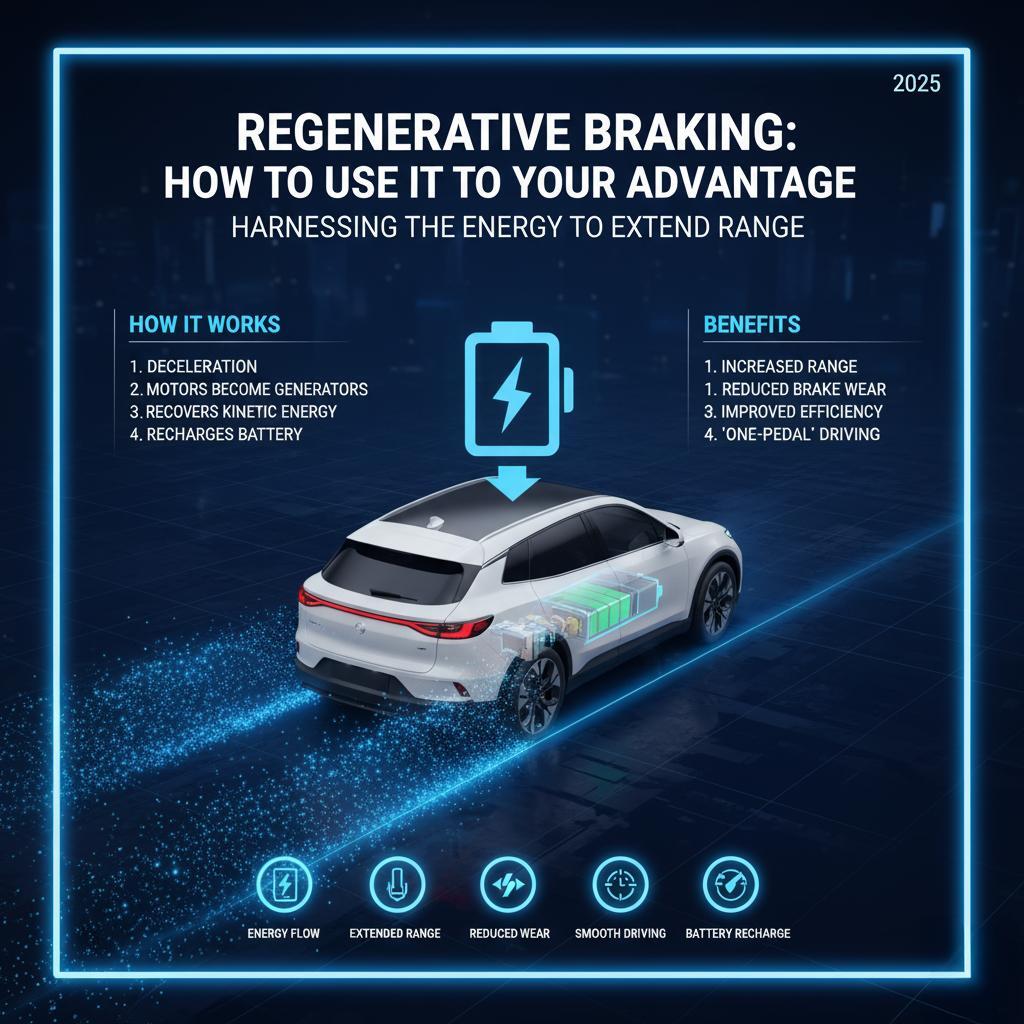
Quick take: Regen turns your EV SUV’s motion back into electricity when you lift off the accelerator or press the brake. Use it smartly—right regen level, good anticipation, and proper technique on hills—and you’ll extend range, reduce brake wear, and make driving smoother. Just remember: it’s a bonus, not a magic refuel.
What regenerative braking actually does (plain English)
-
Your motors run backwards as generators, sending energy back to the battery.
-
Software blends regen with friction brakes when more stopping power is needed.
-
You’ll feel it as a gentle to strong deceleration when you lift off the pedal or pull a regen paddle/select “B” mode.
Typical daily recapture is modest (often in the single digits to low-teens % of energy use). It’s still real savings over time—and it keeps your brake pads happier.
When regen works best (and when it doesn’t)
Great for:
-
Stop-and-go traffic and city driving (lots of slowing events).
-
Long descents where you’d otherwise ride the brakes.
-
Anticipating lights/traffic so you can lift early and coast into a smooth stop.
Limited by:
-
Cold battery: Regen power is reduced until the pack warms up.
-
High state of charge (SoC): Near 100%, the battery can’t accept much energy, so regen fades and friction brakes do more.
-
Very low speeds or emergency stops: Friction brakes take over for stability/safety.
Daily technique: get the most from regen
-
Look ahead and lift early. Treat the accelerator like a “go/slow” pedal—ease off sooner to let regen do the work.
-
Pick a sensible regen level.
-
City: Medium to high regen (or one-pedal) feels natural and efficient.
-
Highway: Lower regen can be smoother; you’ll mostly cruise.
-
-
Blend, don’t yo-yo. Avoid on-off surges. Smooth, steady decel maximizes recovered energy and passenger comfort.
-
Finish with a short brake press. It helps the car come to a clean stop and keeps the friction brakes exercised.
One-pedal, paddles, and “B” modes (what to use when)
-
One-pedal/Max regen: Great for dense traffic and urban driving. Practice until stops are smooth.
-
Regen paddles (left/right): Useful for fine control coming down hills or approaching traffic; hold a paddle for stronger, temporary regen.
-
“B” mode (or similar): Increases default lift-off regen—good for rolling terrain or when you want fewer pedal moves.
Try each setting on a familiar route. Your “best” setup is the one that lets you brake less and coast smoothly.
Hills & mountains: a quick game plan
-
Start the descent with battery headroom (avoid being near 100% SoC).
-
Select stronger regen (one-pedal, “B”, or paddles).
-
Use regen as your primary retarder, but don’t hesitate to blend in friction brakes to keep speed in check.
-
If regen fades (battery full or cold), switch to lower gear modes if offered and rely more on friction—don’t chase regen at the expense of control.
Wet, snow, and low-grip conditions
-
Regen is smooth, but it’s still braking. Traction control will moderate wheel slip.
-
If surfaces are slick, reduce regen strength to avoid abrupt weight transfer and lean on gentle pedal/brake inputs.
-
Always prioritize stability over extra regen.
Towing and heavy loads
-
Extra mass means more kinetic energy to harvest, so regen can be effective on descents.
-
But: many EVs limit regen when towing for stability. Use Tow/Trailer mode and plan longer stopping distances.
-
Watch temperatures on long downhill pulls; take breaks if systems heat-soak.
Brake lights & following traffic
-
Most EVs activate brake lights when lift-off regen exceeds a certain decel level.
-
Still, signal early and keep decel smooth so drivers behind can react.
Battery health & regen
-
Regen is generally gentle on the pack compared with repeated DC fast charging—it’s short bursts, not sustained high power.
-
In winter, precondition while plugged in so the pack accepts more regen sooner.
-
Don’t worry about “using up” the battery with regen—the net effect is favorable for both efficiency and brake wear.
Quick troubleshooting
-
“Regen feels weak today.” Battery is cold or SoC is high; it’ll return as conditions normalize.
-
“Car surges at low speed.” Lower regen level in parking lots; finalize with light brake.
-
“Rusty rotors / squeal.” Use friction brakes firmly once in a while to clean the rotors, especially if you drive mostly on regen.
10-minute practice routine (save this)
-
Find a quiet road with a known stop.
-
Set medium regen; approach from 50 km/h (30 mph).
-
Lift early, aim to reach walking pace just before the line, then finish with light brake.
-
Repeat with higher regen (or one-pedal).
-
Try a downhill segment using paddles or “B” mode; keep speed steady with regen first, brake second.
-
On a cold day, notice how regen increases as the pack warms.
Myths vs. reality
-
“Regen will fully recharge my battery on a hill.” No—it’s a top-up, not a refill.
-
“Max regen is always best.” Not everywhere; pick levels that match traffic and grip.
-
“Using regen wears the battery.” Normal regen is well within design limits and often reduces overall stress by improving efficiency.
Bottom line
Use regen as a precision tool: anticipate, lift early, and pick the right level for the road. You’ll drive farther per kWh, keep your brakes cleaner and cooler, and make every trip smoother—especially in city traffic and on long descents.